

Benefits of AI security code review PR comments
You can get the following benefits with AI security code review PR comments:- Get security feedback without leaving your development workflow
- Identify issues before code review or merge
- Reduce the time between writing code and discovering security problems
- Receive specific recommendations for fixing security issues
- Understand the security implications of your code changes
- Learn about security best practices through real examples
Content of AI security code review PR comment
After the analysis is complete, Endor Labs posts a comment directly on your pull request with the following information:- Summary: A summary of the code changes in the pull request along with the file name and location of the code changes.
- Security Changes: A list of security changes in the pull request along with the file names and location of the security changes.
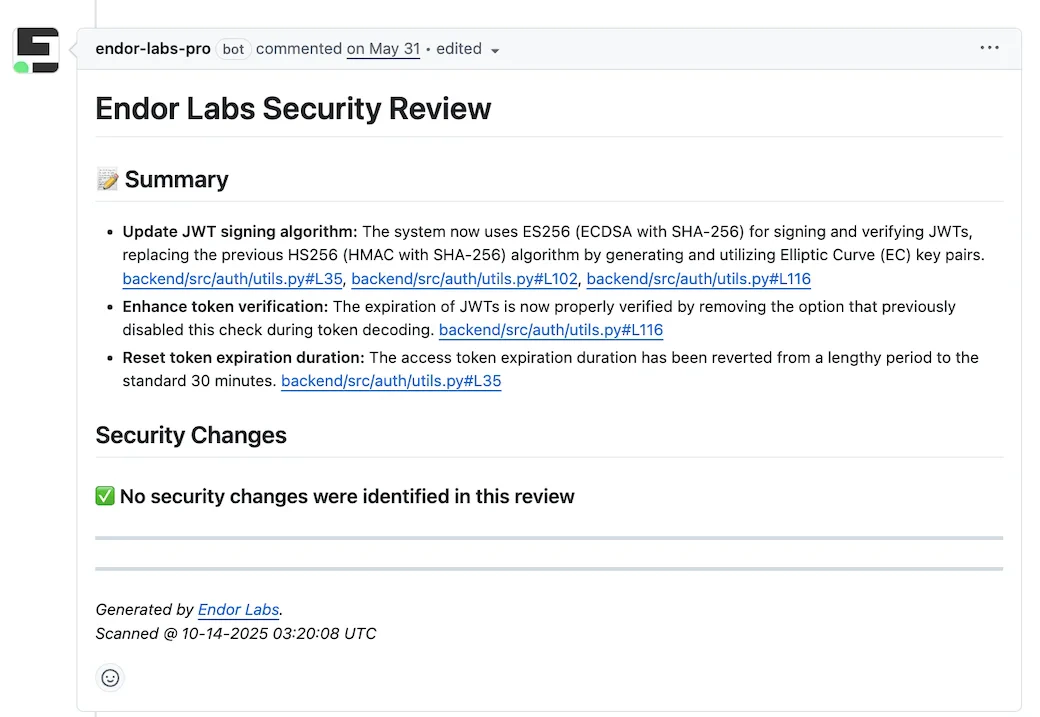
Summary of code changes
The AI security review provides a comprehensive summary of all code changes in your pull request. The summary includes the following information:- Detailed change analysis: What was modified, added, or removed in each file.
- File paths and line numbers: Exact locations of all changes.
- Technical implementation details: Specific functions, configurations, and changes made in the code.
- Impact assessment: Analysis of how changes affect the overall system.
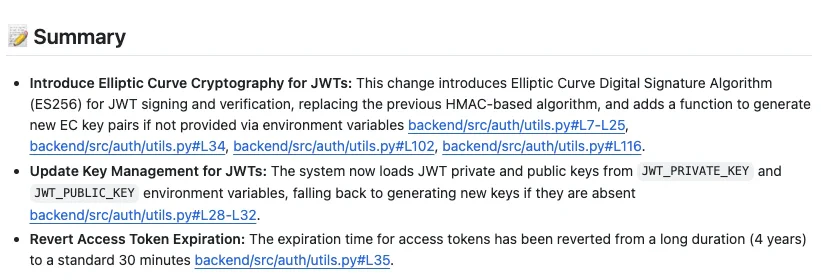
Security Changes
The AI security review analyzes your code changes across different security aspects and provides detailed findings for any security-relevant changes. The following sections describe the security changes in more detail. The following example shows a security changes for a pull request.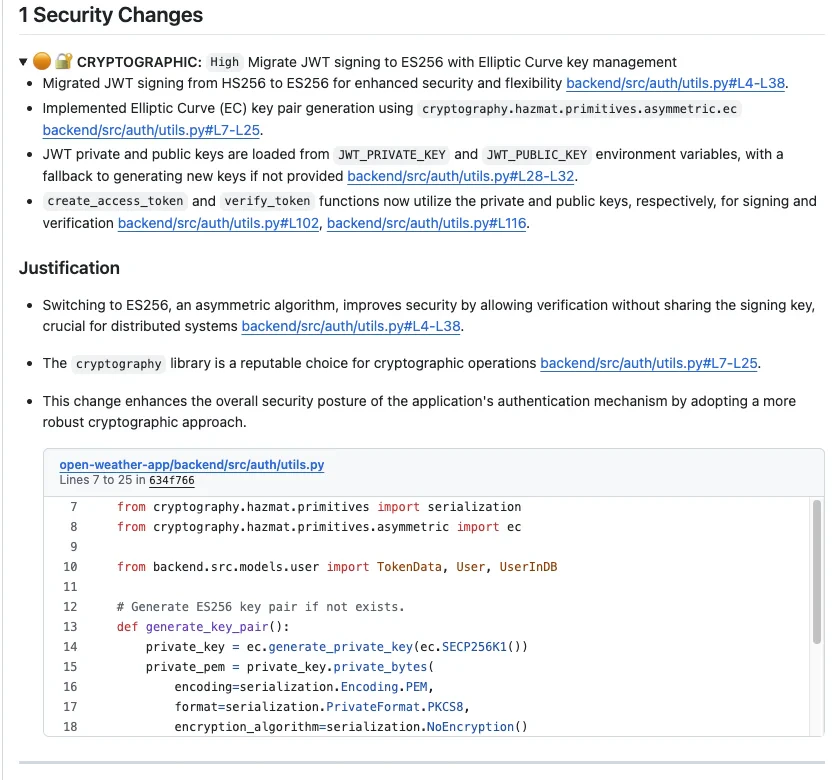
Comment structure of security changes
The comment structure is as follows:- Security Changes Header: Numbered count of security changes found.
- Security Aspect Icons: Visual indicators and category icons for quick identification.
- Severity Level: Critical, High, Medium, or Low classification.
- Detailed Description: Comprehensive explanation of the security concern.
- Code References: Specific file paths and line numbers with clickable links.
- Justification Section: Detailed explanation of why the change poses a security risk.
Severity levels
The following severity levels are used to classify the security changes:- 🔴 Critical: Immediate security threats (prompt injection vulnerabilities, authentication bypasses).
- 🟠 High: Significant security risks (API endpoint issues, access control problems).
- 🟡 Medium: Security concerns to address (PII data handling, dependency security, JWT implementation).
- 🟢 Low: Minor security issues or best practice violations.
Category icons for security changes
The following category icons are used to classify the security changes:- 📦 Dependency: Dependency security, library vulnerabilities.
- 🤖 AI: AI model security, prompt injection risks.
- 🔒 Access Control: Authentication, authorization, session management.
- 🔌 API Endpoint: API security controls, rate limiting.
- 🗄️ Database: Query construction, data access controls.
- 🔐 Cryptographic: Encryption, hashing, key management, JWT implementation.
- 💳 Payment Processing: Financial data security, PCI compliance.
- 🧠 Memory Protection: Buffer overflows, memory leaks.
- 👤 PII Data Handling: PII handling, data classification, local storage security.
- 📝 Input Validation: Data sanitization, injection prevention.
- 🏗️ Infrastructure: Cloud resources, container security.
- 🚀 CI/CD: Build pipeline security, artifact integrity.
- ⚙️ Configuration: Secrets management, environment variables.
- 🌐 Network: Firewall rules, network segmentation.