

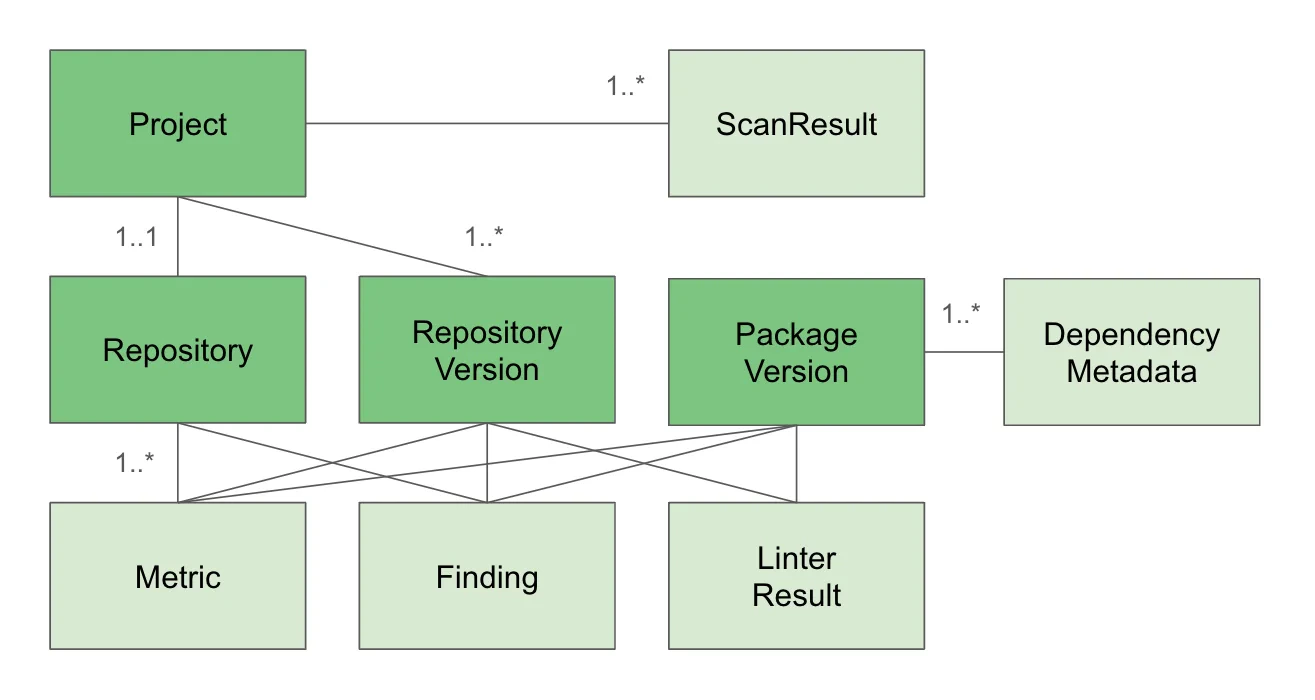
meta.parent_uuid) or a specific field in the object-specific data if the project is not the direct parent (spec.project_uuid if not specified otherwise).
Use the following command to get a list of all objects of a given resource kind in your tenant.
Here are a few useful options:
--count--page-size=1--list-all--filter="meta.parent_uuid==<uuid>"--filter="spec.project_uuid==<uuid>"
Project
- This is the logical root of all the other information for a given project.
- Contains information about the source code location of a project, such as a Git repository, or a package manager package name.
- Does not have a parent and is not associated with a context.
- The object name is the HTTP clone URL, for example:
"https://github.com/definitelytyped/definitelytyped.git".
Repository
- Contains information about the source code for a project.
- Child of a Project and, just like the Project, does not belong to a context.
- There is at most one Repository per Project, but a Project may not have a Repository if there is no source code.
- The object name is the same as the Project.
RepositoryVersion
- Contains information about a specific version of a Repository.
- Has the Project as the parent.
- There are often multiple RepositoryVersions per project.
- Each RepositoryVersion is associated with a Context.
- The object name is the corresponding branch name, tag, or SHA, for example:
"main".
PackageVersion
- Contains information about a specific version of a package and its dependencies.
- Does not have a parent (for historical reasons), but is associated with a Context and connected to the Project via
spec.project_uuid. - The object name is the corresponding package version name in the format
<ecosystem>://<package-name>@<version>, for example:"mvn://org.webjars.npm:types__json-schema@1.2.3".
Resolution errors
Details about any dependency resolution or call graph generation errors for a package version are stored inspec.resolution_errors. There are three categories of resolution errors, each with a separate field that can contain up to one resolution error:
- Unresolved - Details in
spec.resolution_errors.unresolvedif there was an error computing the unresolved dependencies. - Resolved - Details in
spec.resolution_errors.resolvedif there was an error resolving the dependency versions. - Call graph - Details in
spec.resolution_errors.call_graphif there was an error generating the call graph.
status_error field and may also contain details about the target, the operation that failed, and a description of the error. The following status errors are supported:
Below is an example resolution error in the Resolved category:
DependencyMetadata
- Different from other common resource kinds as it represents the relationship between two PackageVersions: The importer and the dependency.
- There is one DependencyMetadata object for every dependency for every PackageVersion.
- Has the importer PackageVersion as the parent and exists in the same Namespace and Context as the parent.
- The object name is the same as the dependency PackageVersion.
-
Combine the object name (
meta.name) and the parent UUID (meta.parent_uuid) to get a unique key. -
Connected to the Project via
spec.importer_data.project_uuid. -
Details about the relationship are stored in
spec.dependency_data. For example:spec.dependency_data.directspec.dependency_data.reachablespec.dependency_data.scope
LinterResult
- Contains the results of scans using third-party programs such as Gitleaks or Semgrep.
- Has a RepositoryVersion or PackageVersion as the parent.
- Belongs to the same Context as the parent.
- Connected to the Project through
spec.project_uuid. - The object name is the name of the rule that created the result, for example:
"gen-shady-links". - The result origin is stored in
spec.origin, for example:"LINTER_RESULT_ORIGIN_SECRETS_SCANNER".
Metric
- Contains the output of the analytics processing.
- Has a PackageVersion, RepositoryVersion, or Repository as the parent.
- Belongs to the same Context as the parent.
- Connected to the Project via
spec.project_uuid. - The object name is the name of the analytic that created the metric, for example:
"package_version_scorecard".
Metric types
There are many different types of Metrics. The specifics are stored underspec.metric_values.<key>.<value>, for example: spec.metric_values.scorefactor.score_factor_list. Some Metrics have more than one key-value field under spec.metric_values. The following table lists all supported Metric types along with the corresponding paths to the Metric specific data under spec.metric_values.
Finding
- Contains details of a problem that needs to be fixed.
- Has a PackageVersion, RepositoryVersion, or Repository as the parent.
- Belongs to the same Context as the parent.
- Connected to the Project via
spec.project_uuid. - There are many different types of Findings and new types can be created by custom Finding Policies.
- The object name is the Finding type, for example:
"outdated_release". For more information, see Finding names and metadata below. - The object description contains a more specific description of the Finding, for example:
"Outdated Dependency @babel/plugin-syntax-async-generators@7.8.4". - Additional finding type specific data is stored in
spec.finding_metadata, for example:spec.finding_metadata.vulnerability. - PackageVersion Findings often involve both the root PackageVersion and a dependency PackageVersion. The following details about the dependency PackageVersion are available directly in the Finding object:
spec.target_dependency_name, for example:"@babel/plugin-syntax-async-generators"spec.target_dependency_package_name, for example:"npm://@babel/plugin-syntax-async-generators@7.8.4"spec.target_dependency_version, for example:"7.8.4"spec.finding_metadata.dependency_package_version_metadata
- The UUID of the DependencyMetadata for the dependency is stored in
spec.target_uuid. - There is one Finding object for every PackageVersion that includes a dependency with a given problem. If 10 PackageVersions include a dependency with a vulnerability then there will be 10 findings for the vulnerability.
Finding names and metadata
The following table lists all supported values for the Findingmeta.name field along with an example value for the corresponding meta.description and an explanation.
Finding categories
The following finding categories are supported as possible values in thespec.finding_categories list. All findings must have at least one category.
Finding tags
The following system defined finding tags are supported as possible values in thespec.finding_tags list and referred to as “attributes” in the Endor Labs user interface. These are different from the free-form custom tags that are stored in the Meta field.
Exceptions
A finding can be exempt from triggering action policies (such as admission and notification policies) if it is matched and marked as dismissed by an exception policy. Exception policies allow you to set any criteria you want to mark findings as dismissed. You can apply an exception policy across all projects, a sub-set of projects, or a specific project, within a tenant. Based on the criteria you set, the exception can persist across multiple package versions. Findings dismissed by one or more exception policies have thespec.dismiss field set to true and
the corresponding policy object UUIDs are listed under the spec.exceptions.policy_uuids field.
They also carry the FINDING_TAGS_EXCEPTION tag.
Action policies
Findings matched by one or more action policies (a.k.a. admission and notification policies) contain the corresponding policy object UUIDs inspec.actions.policy_uuids.
They also carry a tag corresponding to the specific action, for example, FINDING_TAGS_CI_WARNING,
FINDING_TAGS_CI_BLOCKER, or FINDING_TAGS_NOTIFICATION.
ScanResult
- Contains details of a scan such as:
- Configuration
- Host environment details
- Runtime statistics
- Findings
- Policies triggered
- Error logs
- Exit code
- Scan status
- Has the Project as the parent.
- Belongs to the same Context as the scan.